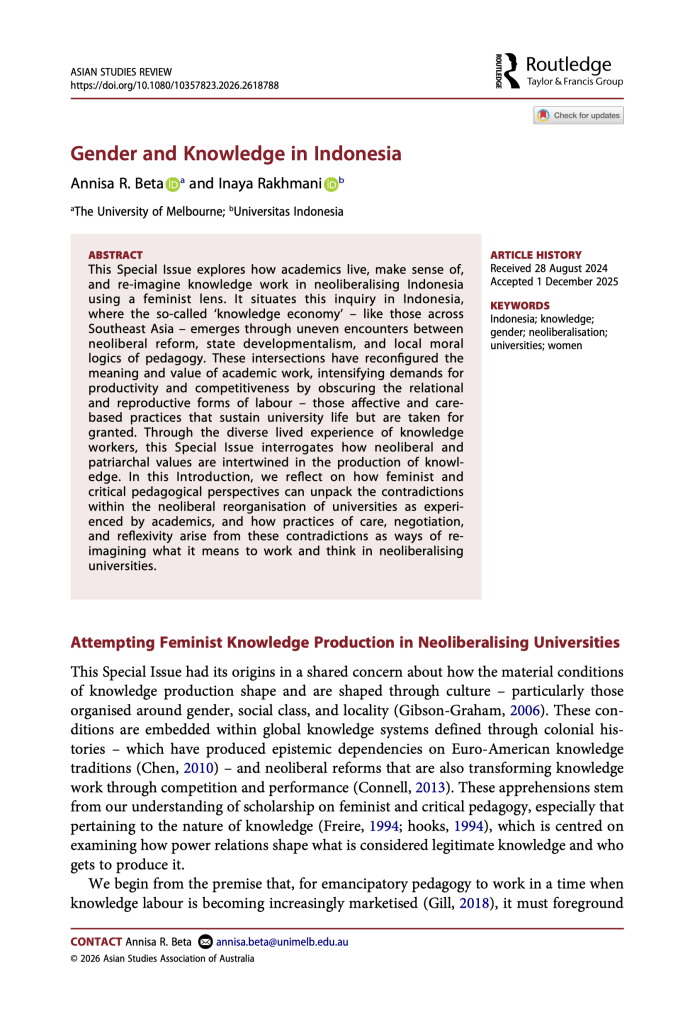
This piece is now out in the world: “Gender and Knowledge in Indonesia“, a Special Issue Inaya Rakhmani and I edited together for Asian Studies Review. I have been sitting with how to write about it outside of academic language. So here is an attempt:
Inaya and I have known each other for quite some time. But we started talking seriously in 2022 about this project. We started by interviewing early-career women scholars in Indonesia. What came back from those interviews was not surprising to either of us, but clarifying: Heavy teaching loads. Temporary contracts. Administrative work that eats into research time but does not appear on any metric that matters. Care work that is expected precisely because it is expected of women.
In 2023, a group formed around these questions. We met regularly online across 2023 and 2024, researchers who would become the contributors to the Special Issue. We made space to think together, which it turns out is genuinely rare.
The Special Issue that came out of all this has four articles. They cover the micropolitics of care inside Indonesian universities, how early-career women scholars experience chronic time scarcity, how precarity pushes women toward forms of academic entrepreneurship that are both constraining and generative, and how social media discourses normalise the figure of the self-sacrificing woman academic through frameworks inherited from the authoritarian New Order period.
What Inaya and I kept coming back to, across all the coordination and editing and long conversations, is that care is the condition that makes intellectual work possible, and refusing to make it visible is a political choice. Writing this together was, in its own small way, a refusal of that erasure.
You can read the full Introduction here.
 Annisa R. Beta
Leave a comment